
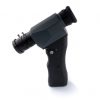


IR MiniC Camera
1,700.00 €
Price without VAT
Main Features
- Operates up to 1900 nm
- High contrast and sensitivity
- Recording and snapshot capabilities
- USB-C connectivity
- Compatible with C-mount lenses
- Detects pulsed and continuous wave (CW) light
2 Years warranty
Description
The MiniC camera captures radiation within the 400–1900 nm spectral range, enabling detailed observation, registration, and recording in the near-infrared zone. It is ideal for infrared microscopy, luminescence studies, document analysis, forensics, art restoration (infrared reflectography), and instrument alignment applications. Equipped with a SONY sensor optimized for IR sensitivity, the camera features micro-lenses on photocells to enhance photon absorption and amplify pixel performance. The camera connects via USB-C and operates in a plug-and-play mode, compatible with Linux and Windows systems using universal drivers.
Typical Applications
- Location and alignment of Nd:YAG Yb:YAG, Yb:KGW,Ti:Sapphire and other IR lasers
- Identification of stray IR reflections
- Observation of GaAs laser diodes, IR LED‘s, dye and other IR-sources
- Forensic analysis on inks, pigments
Downloads:
“Datasheet”
“Software”
Technical information:
| MODEL (1X) | MODEL (2X) | |
| Spectral sensitivity | 400-1900 nm | |
| Power densities for effective viewing: | 5 mW/cm² at 1310nm 10 mW/cm² at 1500nm 200 mW/cm² at 1900nm |
|
| Resolution (center) | 30 Lp/mm | |
| Field of view | 38° | 19° |
| Magnification | 1X | 2X |
| Objective filter tread | F1.3/8mm M25.5×0.5 |
F1.4/16 mm M27x0.5 |
| Objective thread | C-Mount 1″-32 UN | |
| Adjustable iris | Included | |
| Minimum object distance | 0.1m to ∞ * | 0.5m (0.15m) to ∞ * |
| Distortion of image | 0.5% | |
| Video interface | USB – C | |
| Weight | 0.11 kg | |
| Dimensions | 45 x 45 x 27.5 mm | |
| Tripod thread | ¼”-20 UNC | |
| * – MOD can be customized upon request | ||
| Lenses 1X (F1.3/8 mm) and 2X (F1.4/16 mm) are exchangeable. | ||
Standard kit includes:
- MiniC Camera;
- distance ring;
- IR cut-off filter;
- Tripod;
- Software and drivers;
- manual;
- case.
Accessories available upon request:
- Iris diaphragm
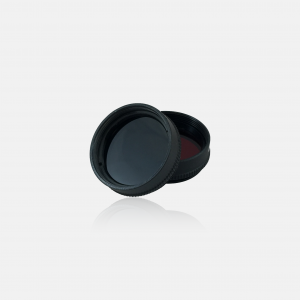
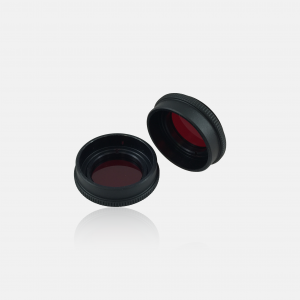
- Neutral density filter to lens 1X (3-5%@1064nm)
- Neutral density filter to lens 2X (3-5%@1064nm)
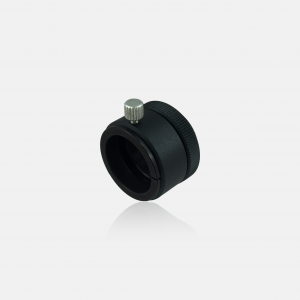
- Microscope adapter
Solar Panel Inspection
When reverse voltage is applied to a solar panel, the silicon p-n junction acts as a light-emitting diode (LED), producing near-infrared light emission through electroluminescence (EL). This occurs via radiative recombination—the process where electrons and holes recombine at the semiconductor junction, emitting photons in the near-infrared spectrum (typically 900–1300 nm wavelength range). Unlike thermal imaging, which detects heat radiation, EL imaging directly detects the light emission from the energized junction, offering a critical advantage: the glass panel surface does not blur or scatter the signal, as it would with thermal radiation.
Real-World Example (21V Panel)

For a solar panel rated at 21V open-circuit voltage, apply a reverse voltage between 24V to 28V using a regulated power supply. This voltage range drives sufficient current through the junction to produce detectable electroluminescence. Defects, cracks, and microfractures within the cells exhibit higher resistance, causing localized variations in carrier recombination rates and thus appearing as bright spots or dark regions in the EL image captured by your IR camera.
Safety Guidelines
Maximum safe reverse voltage typically ranges from 1.2 to 1.5 times the panel’s rated voltage. Exceeding this threshold risks irreversible damage, delamination, or internal short circuits. Always consult the manufacturer’s datasheet for specifications. Use a current-limiting power supply, and limit voltage application to 2–5 minutes per cycle to avoid thermal stress and degradation. This example is educational only.
Available accessories…
-
-
Neutral density filters
- 99.00 €
-
-
-
Microscope adapter
- 110.00 €
-
-
-
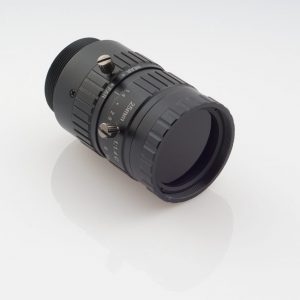
Lens F1.4/25mm
- 200.00 €
-
Related products
-
-
Sale!
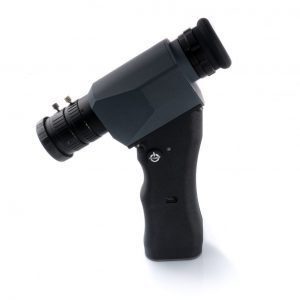
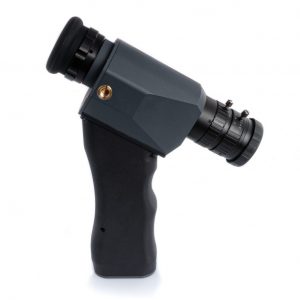
OUTLET: IR Handheld viewer 350 – 1700 nm
- Original price was: 2,640.00 €.1,300.00 €Current price is: 1,300.00 €.
-
Sale!
-
- Out of StockSale!
OUTLET: IR Handheld viewer 350 – 1300 nm
- Original price was: 2,400.00 €.1,200.00 €Current price is: 1,200.00 €.
-
-


-
PixIR
- 1,700.00 € – 1,820.00 €
-